Industrial Flocculant is a practical chemical aid used to separate suspended particles from industrial water. It helps tiny solids form larger, heavier clusters called flocs. These clusters can settle, float, or become easier to filter.
John Gregory, a respected researcher in colloid and water treatment, describes the principle clearly: “Flocculation brings particles together through gentle agitation.” The wording sounds simple. The operation is not.
Inside a treatment tank, a flocculant may connect clay, metal hydroxides, organic matter, or oil-coated particles. Slow mixing then encourages these particles to meet without breaking the growing flocs. Operators watch the water closely. A good process produces visible, compact particles and clearer water above them.
The chemistry depends on charge, dosage, pH, temperature, and mixing energy. Polymer type also matters. Some products neutralize electrical charges, while others create bridges between particles. Overdosing can make the water cloudy again. Underdosing may leave fine solids behind.
This article explains what Industrial Flocculant is, how it works, and where it fits within industrial water treatment. It also examines jar testing, dosing control, sludge formation, and common operating mistakes. Real systems rarely behave perfectly. Raw water changes during the day. A formula that works in the morning may need adjustment later.
That uncertainty deserves attention. Reliable treatment requires testing, measured dosing, proper equipment, and trained supervision. Chemical selection should follow site conditions and applicable safety requirements, not marketing claims alone.
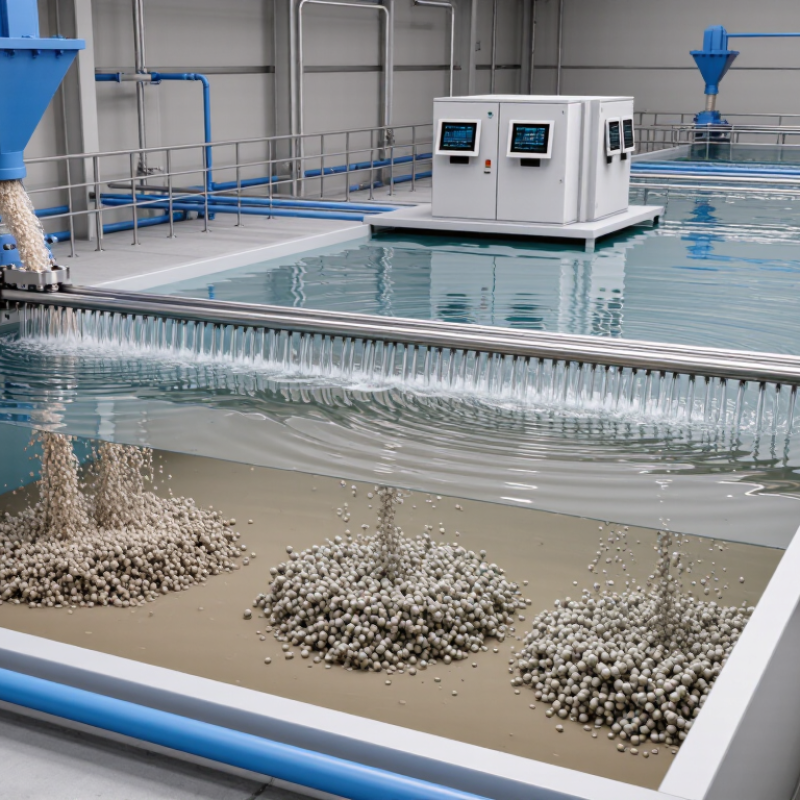
Industrial flocculants are treatment chemicals that gather tiny suspended particles into larger, heavier clusters called flocs. Their main purpose is to improve clarification, filtration, and sludge dewatering in industrial wastewater systems. They are commonly used when clay, metal hydroxides, organic matter, or process solids remain too small to settle efficiently. The WHO/UNICEF JMP 2024 report states that 2.2 billion people lacked safely managed drinking water in 2022. This pressure increases the need for reliable water recovery and careful solids separation.
Inside a treatment tank, particle surfaces often carry similar electrical charges, so they repel each other. A coagulant can reduce that repulsion. Flocculant polymers then connect particles through charge attraction and molecular bridging. The clusters become visible, like soft brown snow, and settle faster. Operators usually confirm performance through jar testing, measuring settling speed, turbidity, and sludge volume. Jar tests matter. The UNESCO World Water Development Report 2024 estimates that agriculture uses about 70% of global freshwater withdrawals, making efficient reuse increasingly important.
Flocculants mainly capture suspended solids; they do not reliably remove dissolved salts or all dissolved pollutants. That distinction is often missed. A practical weakness is assuming one dosage works year-round. It rarely does. Temperature, pH, mixing intensity, and sludge age can change results. Experienced operators adjust dosage gradually and monitor treated-water turbidity rather than trusting a fixed recipe. Poor mixing can break fragile flocs, while overdosing may increase sludge production and operating costs.
It is a chemical that gathers tiny suspended particles into larger, heavier clusters. These clusters settle faster or become easier to filter. The process looks simple. It is not always predictable.
Rapid mixing spreads the chemical through wastewater. Charged molecules reduce particle repulsion. Slower mixing allows particles to collide and form visible flocs. Excessive agitation can break them apart.
Inorganic types include aluminum salts, ferric salts, and mineral-based coagulants. Organic types include synthetic polymers with long molecular chains. Natural polymers are also available, but their performance may vary more.
Selection should begin with water analysis, not product labels. Check pH, turbidity, conductivity, temperature, suspended solids, and organic content. Particle charge, molecular weight, and charge density also matter.
A jar test compares different doses under controlled conditions. Operators can observe floc size, settling time, turbidity, and sludge volume. One successful test is not enough. Wastewater may change hourly.
Not always. Excess chemical can restabilize particles, increase sludge volume, and raise operating costs. Small dosage changes may produce surprisingly different results. More is not automatically better.
Rapid mixing disperses the chemical. Gentle mixing helps flocs grow without damaging them. Excessive shear creates fragile fragments that may pass through filters. Poor mixing can look like poor chemistry.
They should check settling speed, residual turbidity, filtrate clarity, sludge characteristics, and final water quality. They should also review residual chemicals and sludge handling needs. Clear water alone proves little.
An Industrial Flocculant is a chemical agent used to gather fine suspended particles in water or wastewater into larger, heavier groups called flocs. These flocs can then be removed more efficiently through sedimentation, flotation, filtration, or other treatment methods. Flocculants may be organic or inorganic and are commonly available in different forms, including polymers and mineral-based compounds. Their chemical structure and charge determine how effectively they interact with particles and water conditions.
Industrial flocculation generally involves particle destabilization, polymer bridging, aggregation, and separation. The process is widely applied in municipal and industrial wastewater treatment, mineral processing, paper production, and water clarification. Performance depends on factors such as pH, temperature, mixing intensity, particle concentration, dosage, and the type of suspended material. Selecting the right product requires laboratory testing and process evaluation to achieve efficient clarification, reduce chemical waste, and maintain stable treatment results.

 Smedic Tech